What Is Intent Data? Signals, Types and Same-Week Use
What is intent data? Learn the main signal types, how to tell real buying interest from noise, and how to act on a signal the same week.
Intent data is behavioral evidence that an account may be researching a problem, category or vendor. It is not proof that the account will buy.
That gap between research and readiness is where most intent programs fail. A topic surge gets treated as a raised hand, reps get pointed at accounts a consultant or a competitor was reading about, and the follow-up calls land flat. The better question isn't who is researching you. It's what changed at this account recently, and does that change make a conversation worth having this week.
What Intent Data Means in Plain Terms
Intent data is behavioral evidence that helps identify which companies or buying groups are actively researching a product category, problem or supplier, as Bullseye's glossary of buyer intent data defines it. The evidence arrives in two forms. First-party activity happens on properties you own: website visits, pricing-page views, content downloads, webinar attendance, repeat engagement. Third-party activity happens where you have no control: research across publisher sites, search engines, review platforms and other digital properties.
One page view proves nothing. The signal is the pattern, meaning several dated events from the same account close enough together to suggest an active project. That's also what separates intent from two things people mix it up with. Firmographic data describes what a company is, such as industry, size and geography, and changes slowly, as PredictLeads notes in its intent data guide. Ordinary web analytics shows activity without explaining whether it has any commercial meaning. A purchase decision is a third thing entirely. Intent is directional, never definitive.
Picture a shopper who stops at the same storefront three times in one week and reads the same label in the window each time. That's genuine interest, expressed repeatedly. It is not a wallet on the counter, and no sensible shopkeeper rings up a sale on the strength of it.
The three-part test for any signal: What happened, when did it happen, and what could a reasonable person conclude from that fact alone?
Run every signal through that test before it changes a rep's day. Most of them fail the third part, and the ones that pass are the only ones worth building a message around.
Why Buyers Research Before Sales Hears From Them
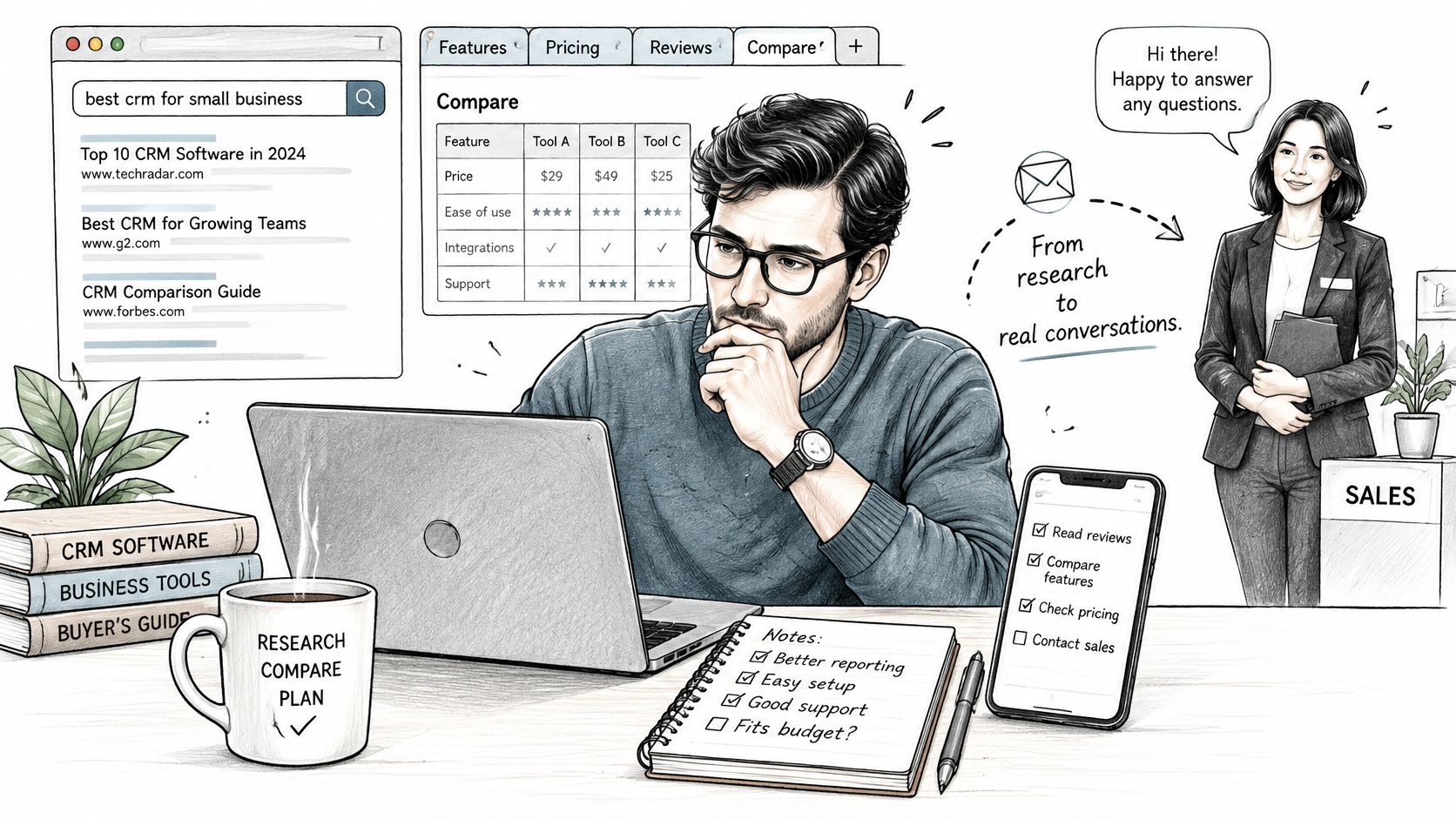
A finance director decides the monthly reporting pack takes too long to assemble. She doesn't call anyone. She searches for comparisons, reads three review pages, downloads a buyer's guide, messages a former colleague about what they use, and only then books a call. By the time a rep sees her name, most of her evaluation is already done.
That pattern is old enough to have a number attached. In research conducted by Google and the CEB Marketing Leadership Council during 2011 and 2012, researchers surveyed 1,500 business leaders who had recently completed major purchases across 22 large B2B organizations. They reported that buyers, on average, did not contact a supplier directly until 57% of the purchasing process was complete, according to the B2B Digital Evolution research.
What the 57% figure does and does not say
It is an average from one sample, not a rule that every buyer waits exactly that long. It doesn't mean sales has no influence earlier. Deals get shaped by the vendor who answers a question in month one and by the one who shows up in month four with a relevant point. The durable lesson is narrower: observable research can run a long way ahead of the first conversation, so inbound forms and cold lists will always arrive late to some accounts.
Signals that reveal the research stage without naming anyone in particular tend to be structural rather than personal:
- A relevant job post: a company hiring its first revenue operations manager is building the function that buys reporting tools.
- A funding event: fresh capital makes budget available, though the timing of spend varies by company.
- A technology in use: a new system in the stack usually means an integration or replacement project is live.
Use those dated events to decide when to reach out and what context to bring. A human still reviews the message before it goes anywhere.
The Signal Types Behind Intent Data
| Signal type | Where it comes from | Example | How to read it |
|---|---|---|---|
| First-party activity | Your own website and product | Repeat pricing-page visits, documentation reads, demo request | Strongest context because the company controls the source |
| Engagement activity | Email, webinars, content downloads | Webinar registration, whitepaper download | Useful but noisy; may come from students or competitors |
| Third-party research | Publisher sites, search, review platforms | Topic research across sites in one account | Directional; often anonymous and account-level |
| Dated business events | Job posts, funding, technology adoption, leadership hires | New VP of Sales hire, new software in use | Shows a possible need; timing varies by event |
| Firmographic fit | Company records | Industry, company size, geography | Not intent; use it to filter, not to rank research |
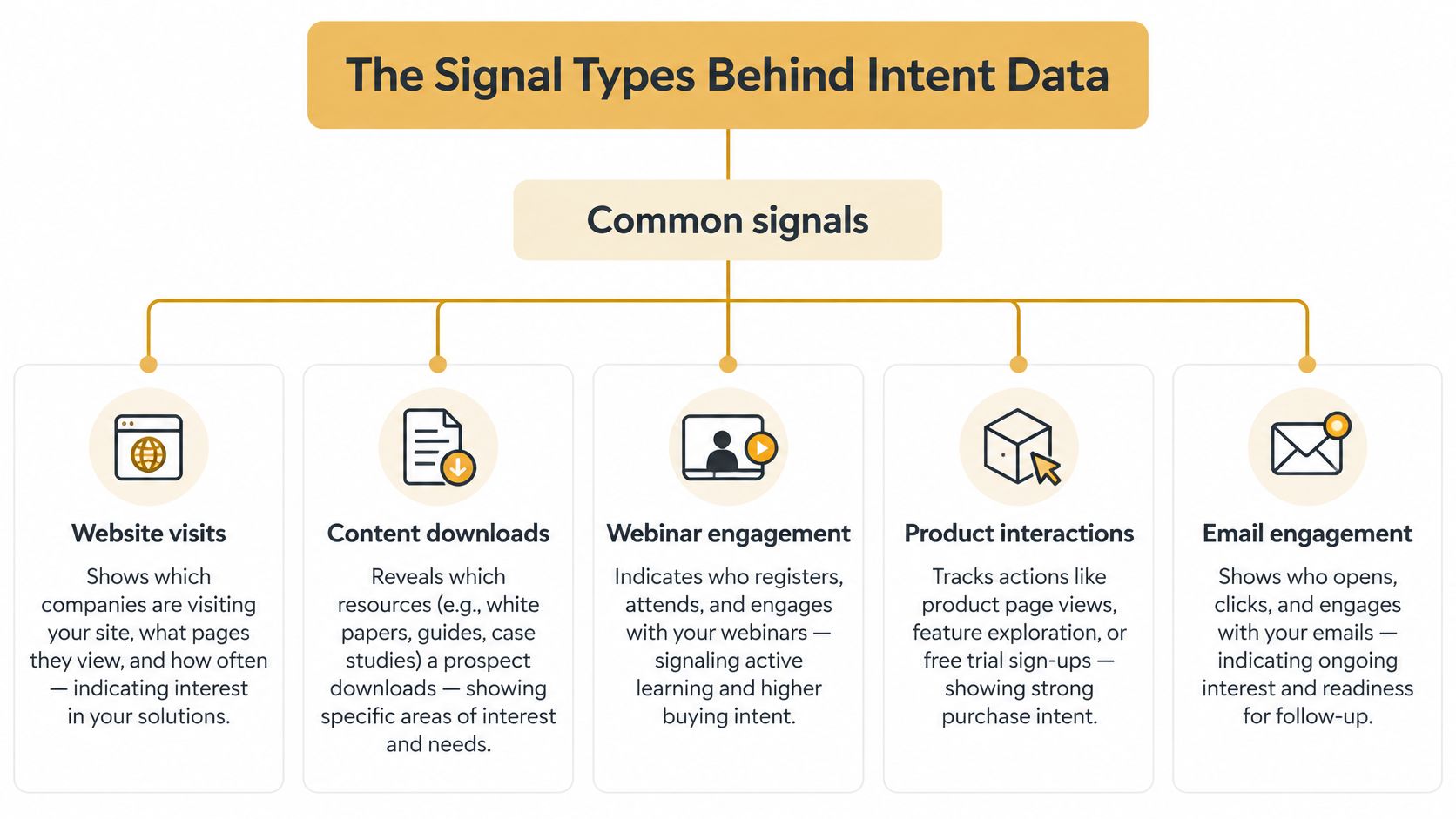
Demandbase's definition of intent data lists the common signals as website visits, content downloads, webinar engagement, product interactions, email engagement, search behavior and topic research, and it's careful to call the result an indicator of active interest rather than proof of readiness. That framing matters. The list describes behaviors, not budgets.
Why some rows carry more weight than others
First-party activity wins because you control the source and can tie it to your own customer journey. Engagement activity is weaker: an open or a download can come from anyone with an inbox. Third-party research widens coverage beyond your own properties, which is valuable, but it is often anonymous and account-level, as Common Room explains in its intent data overview. Business events sit between the two, since they show a possible operational need without confirming a purchase. Firmographic fit isn't intent at all, yet it does useful work by filtering out accounts that will never buy.
Rule of thumb: one signal starts a conversation with yourself. Two independent signals, one of them recent, start a conversation with the account.
Teams that would rather buy the signal than assemble it can start from lead lists with dated buying signals, where each company arrives with the event that put it on the list.
On sourcing: first-party data comes from your analytics and forms, third-party data from an intent network, and business events from public records and job boards. Dedicated intent platforms are the better fit for a team running a large account-based marketing program with analysts on staff to interpret the feed. For a five-person sales team without that analyst, the same money usually buys more meetings through simpler signals.
Which Signals Carry the Most Weight
Not every signal deserves the same weight. One published analysis graded them against software-purchase activity, and the spread is wide enough to change how an account gets scored.
| Signal | Reported correlation | How to use it |
|---|---|---|
| AI-tool adoption | +46% | Strong when recent; recalibrate against your own conversion data |
| Headcount growth | +38% | Useful with fit; confirms an operational need |
| Recent purchases | +38% | Shows active spending; check whether it fits your offer |
| VP-level hiring | +28% | Good timing signal; confirm the role matches your buyer |
| Recent funding | +25% | Shows budget may be available; weight by recency |
| Job-posting increases | +7% | Weak alone; treat as supporting evidence only |
Prospeo's analysis of B2B buying signals reports those correlations with software-purchase activity and states plainly that they are not universal causal benchmarks. Treat them as a starting point and recalibrate against a quarter of your own conversion data before you trust any of them.
Why timing changes the weight
Different events run on different clocks. A technology change can point to a durable implementation or replacement project that stays live for months. Content engagement is transient and fades within days. Hiring signals reveal an emerging operational need but may precede a purchase by weeks or months, which is long enough for a competitor to arrive first.
The scoring model that holds up is simple: weight recency, repeat activity, account fit and the number of independent signals, then decay stale events after a fixed window. Keep the underlying evidence for each point so a rep can see why the account moved. Measure the results that matter, meaning qualified meetings, opportunities and revenue, rather than the size of the intent list.
Weight decides tone as much as priority. A signal doesn't make a call warm by itself, and the difference between cold and warm calling is whether you arrive with context the buyer recognizes as their own. Reading a comparison page isn't permission to be familiar. It's permission to be relevant.
Before any signal raises an account's priority, check three things:
- The date. An event from last month is history. An event from last week is a reason to call.
- The source type. First-party beats third-party beats a single job post, every time.
- The stated reason. If nobody can write down in one sentence why the account was chosen, it wasn't chosen.
Where Intent Data Misleads and How to Handle Privacy
Three claims get repeated often enough that they need answering, because each one leads a revenue leader into a bad decision.
Claim one, a signal identifies a buyer. It identifies activity. The person reading a comparison page could be an employee, a consultant, a student, a competitor or an existing customer. The Growth Syndicate's guide to intent data in B2B makes the related point that a signal can show which accounts might be in market without establishing whether they will buy, and that most third-party intent arrives at the account level rather than naming the relevant person.
Claim two, a high score means a live deal. A score says nothing about budget, authority or urgency. Those still come from a conversation.
Claim three, anonymous company intent is risk-free. Identifying a business visitor can involve processing personal data. A legal analysis cited by Albacross's review of intent data practice notes that the EU Court of Justice treated dynamic IP addresses as personal data where the website operator has legal means to identify the visitor, and that GDPR direct marketing still requires a lawful basis. Third-party intent can also depend on cookie or bidstream tracking, which raises sourcing and consent questions long before anyone sends an email.
What to keep in place: documented data provenance for every source, retention rules that delete old signals, suppression procedures that run, and a clear separation between company-level prioritization and person-level contact.
Never message someone in a way that implies you observed their private browsing. Refer to the public event you can name.
Keeping a lead defensible is mostly about visibility. Each lead should display its reason and its source, a reviewer should be able to undo a change, and the whole record should stay auditable.
How to Act on a Signal the Same Week
A signal that sits in a dashboard for three weeks is a news item, not an advantage. The sequence below turns one dated event into a human-approved conversation, and each step exists to stop a specific failure.
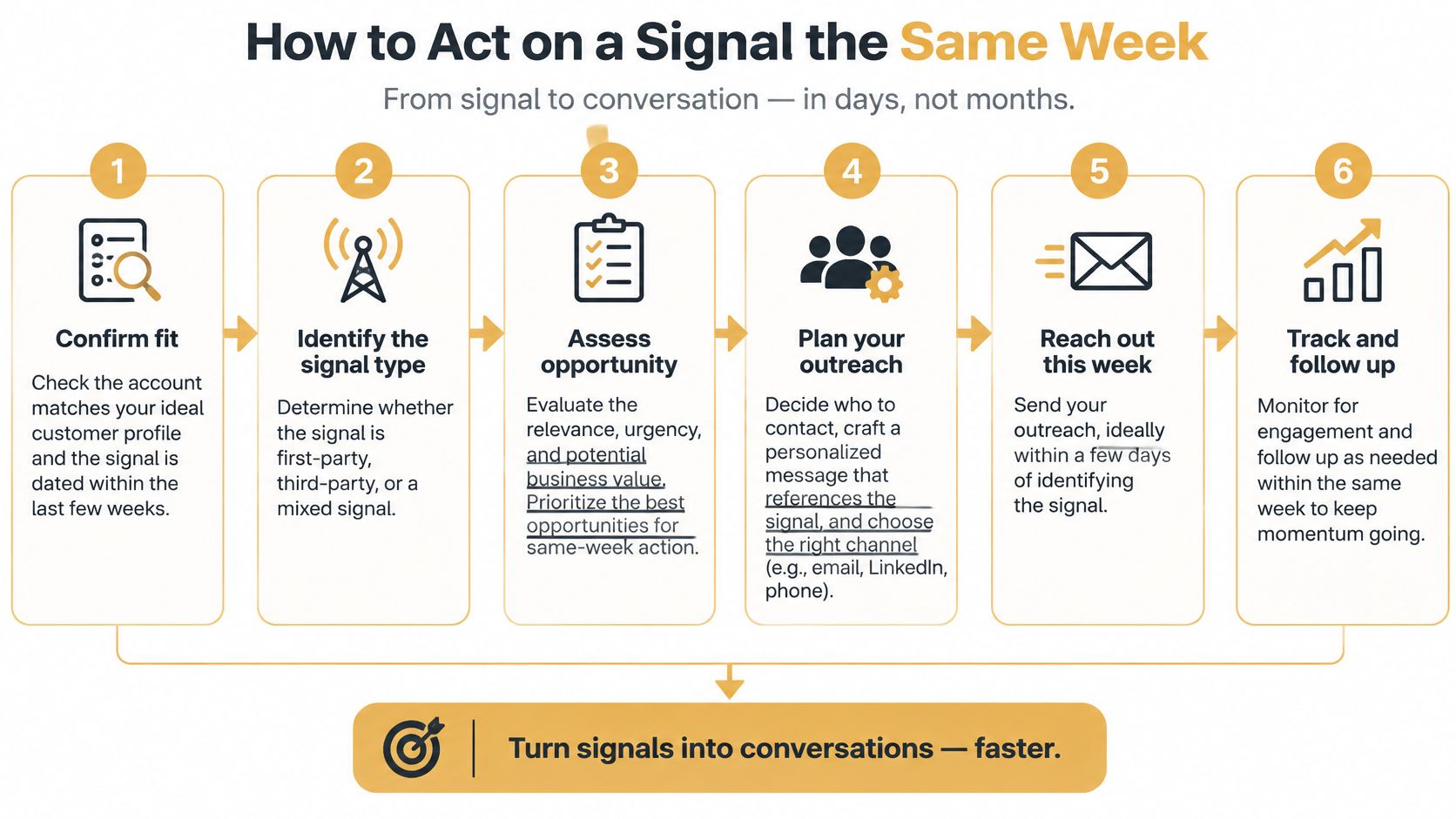
1. Confirm fit and date. Check the account against your ideal customer profile and confirm the event is recent, within the last few weeks. Skipping this is how rep time disappears into companies that were never going to buy.
2. Name the signal type and find a second one. First-party, third-party or a business event, and then look for one independent event that confirms it. First-party signals give the clearest context because the company controls the source, as Foundry explains in its comparison of first-party, second-party and third-party intent, and that context is what makes a same-week response specific instead of generic.
3. Hypothesize the decision maker by role. If a company hired a VP of Sales last month, that person owns the problem. Write their title and the reason the account was selected into the record before drafting anything.
4. Read the actual page, post or event. Open what the account saw. The difference between "I saw you're hiring" and "you're hiring a manager to own pipeline for the first time, which usually means the reporting is manual" is the difference between a template and a message.
5. Draft one personalized touch. A call opener, an email, or a LinkedIn step that addresses the observed topic. SMS stays off the table until carrier registration is complete, and even then it's a channel for people who already know you.
6. Get human approval, then run it in a sequence. Build the sales cadence so the touches stop the moment the prospect replies, and launch it inside a campaign so the results are measurable by source rather than remembered anecdotally. Undo matters more than it sounds: Sales Montana's Write access level lets a rep add or update leads, notes, tasks, callbacks, queue a lead, set priority and next touch, move a deal, draft an email, add a number to do not call, and undo a change, so a misread signal becomes a one-click reversal instead of a cleanup project.
7. Log the outcome. Record whether the signal produced a reply, a meeting or a disqualification. Without that, the next scoring pass is guesswork, and the same weak signals keep floating to the top.
A good first day under this process looks unimpressive on paper: eight or nine accounts, each with a date, a source and a one-line reason. It is not a list of forty hot accounts with no explanation behind any of them.
Decide Whether to Start Acting on Intent Signals
Start with one segment if three conditions are true. You have a pitch that has booked meetings before. You can verify each account before a rep touches it. And one named person will approve every send. If any one of those is missing, the signals will pile up in a spreadsheet and nothing will happen.
If the missing piece is the list or the people to work it, there are two paths. Sales Montana's trained SDRs run calls, email and LinkedIn inside the customer's own workspace, with every call recorded and visible. Or run it in-house with Montana, the AI head of sales, who finds buyers from dated signals, plans each rep's calls, emails and LinkedIn touches with a reason for each, logs outcomes and moves deals after every interaction, while a human approves everything that goes out.
The trial runs 7 days with 100 credits and no card needed. The user approves the businesses they like, gives a work email, and lands in a live first campaign. Plans are Solo at $49 a month for 1 user, Team at $99 a month for up to 3 users, and Organization at $297 a month for unlimited users.
Run one segment for a week. Then review the reason and the outcome on each account before widening the list, because the point of intent data was never a longer list of names. It was a better reason to pick up the phone.
Intent signals are only worth the work if something happens within days of the event, and Sales Montana is built around that timing: Montana finds buyers from dated signals, plans each rep's calls, emails and LinkedIn touches with a stated reason, logs every outcome and moves the deal, while a human approves every send. If the list and the calls are the part you'd rather hand off, trained SDRs from Sales Montana run outbound inside your own workspace. Start with the 7-day free trial, 100 credits, no card needed, and run one segment for a week before you scale it.
Let Montana run your outbound
Leads, calls, email and LinkedIn in one place. 7 day free trial with 100 credits, no card needed.
Larger team? Book a demo