Lead Scoring Guide: Models, Thresholds and Validation
Lead scoring ranks leads by fit and timing. Learn the models, build a simple score, set thresholds and validate it against past deals.
Lead scoring gives each lead a number that estimates how likely it is to buy soon, built from fit and timing. But if a sales manager can't see why a lead earned its score, how can that number justify the next call?
A useful score makes the reasoning visible. It distinguishes a company that matches the target customer from one showing a recent buying signal, then helps a rep decide which deserves attention first. It doesn't prove that a buyer has budget, wants a meeting, or will become revenue.
What Lead Scoring Is and Which Model Fits
Lead scoring is a prioritization system, not a substitute for qualification. It combines evidence about the company, the buyer's role, and the timing of a possible purchase into a consistent ranking.
An emergency room triage desk offers a useful analogy: staff prioritize urgency rather than arrival order. Sales managers use scoring to make a similar allocation decision, directing limited attention toward the prospects most worth investigating.
The idea predates modern software. The BANT glossary traces Budget, Authority, Need and Timeline to IBM's structured qualification approach, which made subjective sales judgments more repeatable. Later point-based systems applied similar logic to CRM records and marketing activity.
Lead scoring model types compared
| Model type | How it scores | Best when | Main weakness |
|---|---|---|---|
| Rule-based points | Adds or subtracts fixed points for attributes and actions | A team is launching and needs a score a rep can explain | Points reflect opinion and go stale without review |
| BANT-style checklist | Marks Budget, Authority, Need and Timeline as met or not met | Owner-led sales involve few deals and long conversations | Coarse, with little ranking between leads that pass |
| Predictive model | Learns weights from past won and lost deals | A team has a steady history of closed outcomes and someone who owns the data | Needs enough outcomes and is harder to explain to reps |
| Hybrid | Fixed fit rules plus a learned timing weight | Fit rules are stable but timing signals change often | Separate components require documented maintenance |
A rule-based model is a sensible starting point when outcome history is sparse. A predictive model becomes worth testing when the team has enough closed outcomes to create separate training and test sets, including meaningful examples of both success and failure.
Practical rule: Start with rules a rep can explain in a minute. Add complexity only when testing shows that it improves prioritization.
The score ranks leads for attention. It doesn't forecast revenue, and a point total isn't a calibrated purchase probability unless validation establishes that relationship.
Separate Fit, Intent and Engagement Signals
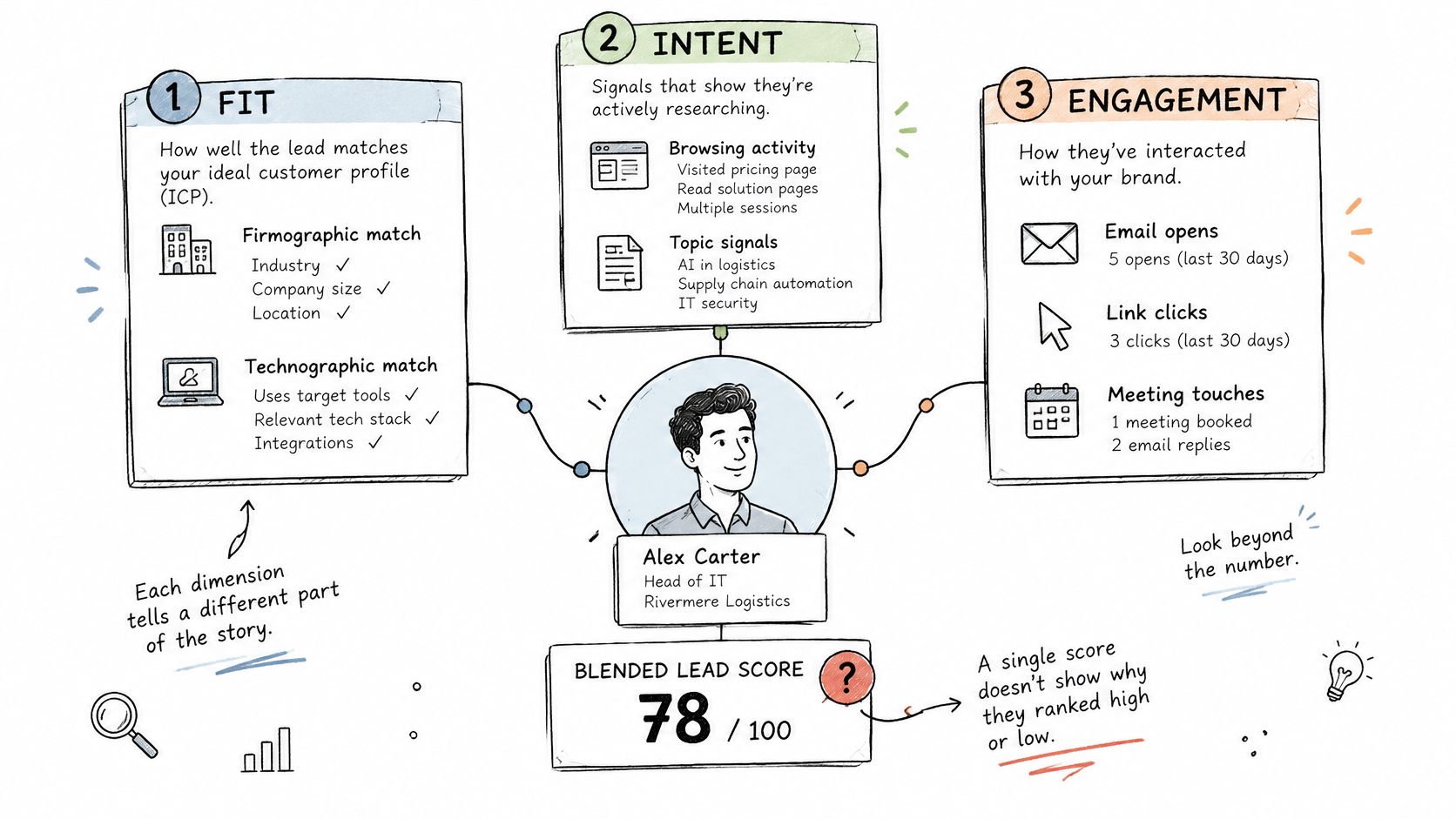
A blended score can hide incompatible reasons for a high ranking. A target account with a relevant hiring announcement shouldn't look identical to an unsuitable company whose employees browse the website repeatedly.
Keep the underlying dimensions visible:
- Fit describes firmographic and technographic match, including industry, company size, location, buyer role, and relevant software.
- Intent describes evidence of possible research or buying readiness, including topic activity and dated business changes.
- Engagement describes first-party interactions, such as replies, meetings, and identifiable website activity.
Intent deserves particular scrutiny. The Captiwate analysis of B2B intent data explains how residential, mobile, VPN, and cloud-routed traffic can undermine company attribution. Anonymous research isn't proof that an identifiable buying committee wants a sales conversation.
Match the evidence to a route
| Evidence pattern | Appropriate action |
|---|---|
| Strong fit and strong intent | Route for prompt rep review, with the evidence checked before outreach |
| Strong fit with no visible intent | Keep in a research queue until a relevant dated signal appears |
| Strong intent with weak fit | Check the segment and attribution before spending rep time |
| Weak fit and weak engagement | Exclude or place in an appropriate nurture process |
Consider a software integration seller. A target company adopting a compatible platform presents a plausible reason to investigate; an unrelated business researching the same topic doesn't become qualified merely because its activity is recent.
Test each signal against an untriggered baseline. Compare signal-to-meeting and signal-to-qualified-opportunity rates between otherwise similar accounts with and without the signal, using the same observation window and outreach treatment.
If the triggered accounts don't outperform the baseline, reduce the signal's weight or remove it. Preserve the separate dimensions in the rep's view so the ranking remains explainable even when a combined number controls routing.
Build a Fit and Timing Score Step by Step
A first model should be small enough to maintain in a spreadsheet. Teams that prefer a starting workflow can use scored lead lists, but the same discipline applies: every selected lead needs evidence that explains its priority.
In Sales Montana's buying-signal workflow, each search finds companies showing that signal, scores them, and adds them to the campaign. Each lead carries the signal, its date, and why this lead, why today.
Assemble the first version
The following is a hypothetical starting model, not an industry benchmark. Its weights, sample sizes, and decay windows are working choices to test against actual outcomes.
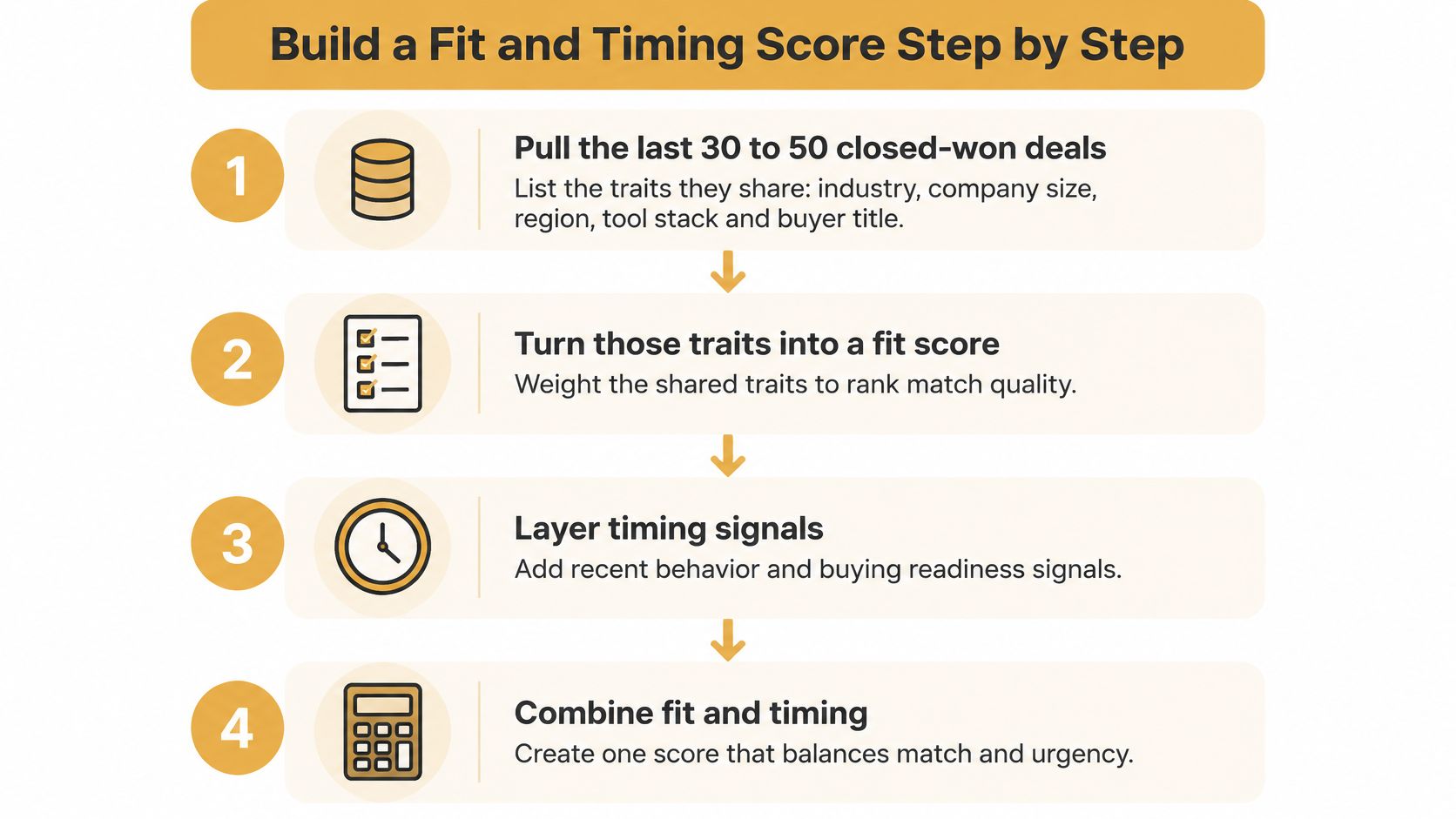
- Inspect recent wins. Pull the last 30 to 50 closed-won deals and list shared industry, company size, region, tool stack, and buyer-title traits. Include lost deals as a contrast so common market characteristics don't get mistaken for distinctive buying signals.
- Allocate the fit points. Give fit a maximum of 60 points using the example below. Check actual purchasing responsibility rather than assuming every senior title identifies a buyer.
- Choose dated signals. Start with three to five candidate timing signals, such as relevant hiring, funding, or technology adoption. Select only those with a credible connection to the offer, keeping timing and engagement together within the remaining 40 points.
- Apply decay. Reduce each timing or engagement contribution by half after its stated window, repeating the reduction as further windows pass. Undated signals shouldn't receive freshness points because nobody can verify when they mattered.
- Combine without hiding. Add the contributions into a score from 0 to 100 while retaining separate fit, timing, and engagement fields. Don't count the same event repeatedly just because it appears in several places.
- Audit the top-ranked records. Inspect the top 50 leads by hand and flag evidence a rep wouldn't trust. Remove unsupported signals rather than adjusting points merely to make favored accounts rank higher.
Example fit, timing and engagement points for a first score
| Signal | Dimension | Example points | Decay rule |
|---|---|---|---|
| Company size inside the target band | Fit | 15 | None, reviewed yearly |
| Industry matches recent wins | Fit | 20 | None, reviewed yearly |
| Decision maker title matches won deals | Fit | 15 | None, reviewed yearly |
| Uses a tool the offer integrates with | Fit | 10 | None, reviewed yearly |
| Fit total | Fit | 60 | Reviewed yearly |
| Relevant hiring post | Timing | 15 | Half of points after 3 months |
| New funding round | Timing | 10 | Half of points after 6 months |
| Replied, visited pricing or opened several emails | Engagement | 15 | Half of points after 30 days |
| Timing and engagement total | Timing and engagement | 40 | Set per signal above |
The engagement row represents a capped bucket, not permission to stack every action indefinitely. Replies, pricing visits, and email opens should remain distinguishable so testing can determine which deserves credit.
A working first version should rank recent wins near the top when reconstructed with evidence available at the scoring date. Checking the close date can expose obvious mismatches, but genuine prioritization testing must also score prospects before the outcome became known.
Set Score Thresholds Against Rep Capacity
Lowering a cutoff gives reps more possible buyers to investigate, along with more unsuitable leads. Raising it reduces wasted effort but can leave viable accounts outside the active queue.
That's the practical trade-off between precision and recall. Precision concerns the quality of the selected group; recall concerns how much of the promising population the system captures.
The lead-classification study using Random Forest and SMOTE illustrates why evaluation should include both measures rather than overall accuracy alone. When non-buyers dominate a dataset, a seemingly accurate model can still miss the buyers worth contacting.
Score bands and what each band triggers
These are illustrative routing bands for the hypothetical score, not universal qualification thresholds.
| Score band | Route | Who acts | Review rule |
|---|---|---|---|
| 80 to 100 | Straight to a rep's queue | Rep, after a same-day check of the signal and date | Count how many leads fill a rep's day and adjust the cutoff |
| 60 to 79 | Rep queue after approval | Rep or trained SDR, once outreach is approved | Compare meetings from this band with the band above |
| 40 to 59 | Research or nurture queue | Assigned researcher or account owner | Reassess when new evidence arrives |
| 0 to 39 | Exclude from active outbound | RevOps or the account owner | Reopen only after fit or relevant evidence changes |
Start with the rep's available working time, not an attractive round number. Existing follow-ups, scheduled meetings, and account research all reduce the room for new leads, so the highest band should fit the capacity that remains.
Strong leads can go straight to the customer's reps, while borderline leads wait for the customer's approval. Queue assignment isn't permission to send; reps or trained SDRs still review outreach before it goes out.
Set an economically sensible cutoff
Compare the expected value of a qualified meeting with the time cost of investigating a false positive. A low-probability account may still deserve attention when the potential opportunity is valuable and the verification work is short.
Conversely, a high-scoring account can be a poor immediate assignment if it requires extensive research that the rep can't complete. Route that work to a research queue rather than filling the call queue with unfinished tasks.
A threshold is a staffing decision as well as a modeling decision.
Review the bands after each quarter and after material changes to messaging, pricing, or the target market. Adjust the cutoff when workload or meeting quality changes, not merely when the average score moves.
Validate a Score Against Past Outcomes
A backtest is unreliable if the model can see information that became available after the decision. Freeze every lead's features at the historical scoring date, then compare its ranking with the outcome that followed.
Use older deals for training and newer deals for testing. Random splits can put related account history on both sides of the evaluation, while fields such as final lead status, closing notes, or later activity dates can reveal the answer directly.
A B2B software-company case study compared 15 classification algorithms using CRM records collected from January 2020 through April 2024 and reported 98.39% average accuracy for gradient boosting on that dataset. That result doesn't establish an expected performance level for another business; it demonstrates why the dataset, features, and evaluation method matter alongside the algorithm.
Read the measures together
- Accuracy measures the share of predictions classified correctly. It can flatter a model when most leads never buy.
- Precision measures the share of prioritized leads that meet the chosen qualification outcome.
- Recall measures the share of all qualified leads the model identifies.
- F1 score balances precision and recall, helping expose a model that performs well on only one.
- Confusion matrix separates correct decisions from false positives and false negatives.
- ROC-AUC evaluates ranking discrimination across cutoffs, rather than at the operating threshold alone.
- Lift compares outcome rates between groups. For this operational check, divide the top band's win rate by the bottom band's win rate.
Keep the outcome consistent. A model tested against qualified meetings shouldn't be described as predicting closed-won revenue, and accounts still in an active buying cycle shouldn't automatically count as failures.
Test whether complexity earns its place
The Sales Montana CRM provides the record-keeping context for this workflow, but the evaluation needs a separate historical snapshot. A current record can be accurate today while still containing information that wasn't available when the original decision occurred.
Run the predictive model and the simple points baseline on the same test accounts, using the same capacity limit. Compare which model places more promising leads into the workload a rep can handle.
If the predictive model barely improves that decision, keep the simpler score. Reps can inspect its reasoning, RevOps can repair it, and managers can challenge a rule without interpreting an opaque prediction.
How AI Supports Lead Prioritization
AI can learn relationships between CRM features and later outcomes, then rank leads by estimated conversion probability. It can't turn an inferred pattern into proof that a particular buyer is ready.
A defensible recommendation distinguishes observed evidence from model inference. A dated hiring post is observed evidence; the conclusion that the company may need additional software is an inference that still needs a rep's judgment.
Connect ranking to execution
Sales Montana is an AI CRM that runs itself, with Montana, its AI head of sales, driving the CRM workflow. He finds buyers, plans each rep's calls, emails, and LinkedIn touches, then logs outcomes and moves deals after interactions, with proposed changes available for acceptance or reversal.
The operating channels remain explicit:
- Calls use a single-line power dialer.
- Email goes from the rep's own mailbox.
- LinkedIn steps are tracked tasks the rep completes manually.
- SMS is available after carrier registration.
A human approves every send. The customer can also accept or reject leads before a campaign goes live, keeping discovery separate from permission to contact.
Call feedback adds another source of evidence. AI call scoring evaluates conversations, which is different from predicting a prospect's buying likelihood; conversation reviews can inform coaching without being treated as purchase intent.
For teams that want outbound handled for them, trained SDRs from the Sales Montana team can run the work inside the customer's workspace. Human approval still applies.
The plans are Solo $49 a month (1 user), Team $99 a month (up to 3 users), and Organization $297 a month (unlimited users, manager tools). The choice of plan doesn't change the central scoring principle: the rep or trained SDR remains responsible for the outreach decision.
Keep AI Scores Fair and Human Approved
A model trained on past conversions can repeat old territory, industry, title, and channel biases while making those preferences appear objective. Historical wins reflect where the business previously invested attention, not necessarily every market where it could succeed.
The thesis on ethical challenges in AI-driven lead scoring identifies data quality, GDPR uncertainty, transparency, organizational readiness, and continuous human review as implementation concerns. Its central operational lesson is that AI should support human judgment rather than replace it.
Make review possible
- Keep an audit trail. Record the evidence, timestamp, scoring rule or model version, and reason each lead received priority.
- Limit unjustified attributes. Exclude sensitive information and challenge proxy attributes that lack a legitimate commercial purpose.
- Compare market segments. Review scores, acceptance decisions, and outcomes across regions, industries, and company sizes each quarter.
- Watch for disappearing evidence. A removed hiring post shouldn't remain an unquestioned active trigger; retain its history and reassess its current relevance.
- Record overrides. Give reps a reason field when they reject recommendations, so corrections become reviewable rather than invisible exceptions.
Uneven results deserve investigation, not an automatic conclusion that the model is unfair. A segment may have missing contact information, inconsistent outreach, or a different sales cycle; the manager needs enough detail to separate those explanations.
Preserve meaningful approval
Privacy obligations depend on the information collected, its purpose, and the markets involved. Teams should obtain legal advice for their own operations instead of treating a scoring feature or a human approval button as proof of GDPR compliance.
Approval only matters when the reviewer can see the evidence and has authority to stop the action.
Sales Montana finds businesses matching the ideal customer description, including the decision maker's email, direct number, and LinkedIn. The customer swipes yes or no on each business, and the first campaign uses the leads retained.
Montana, the AI head of sales, supports that approval process by presenting the lead's signal and proposed next action. Reps or trained SDRs review cold outreach and automated follow-up, and a human approves every send.
Common Lead Scoring Mistakes and How to Fix Them
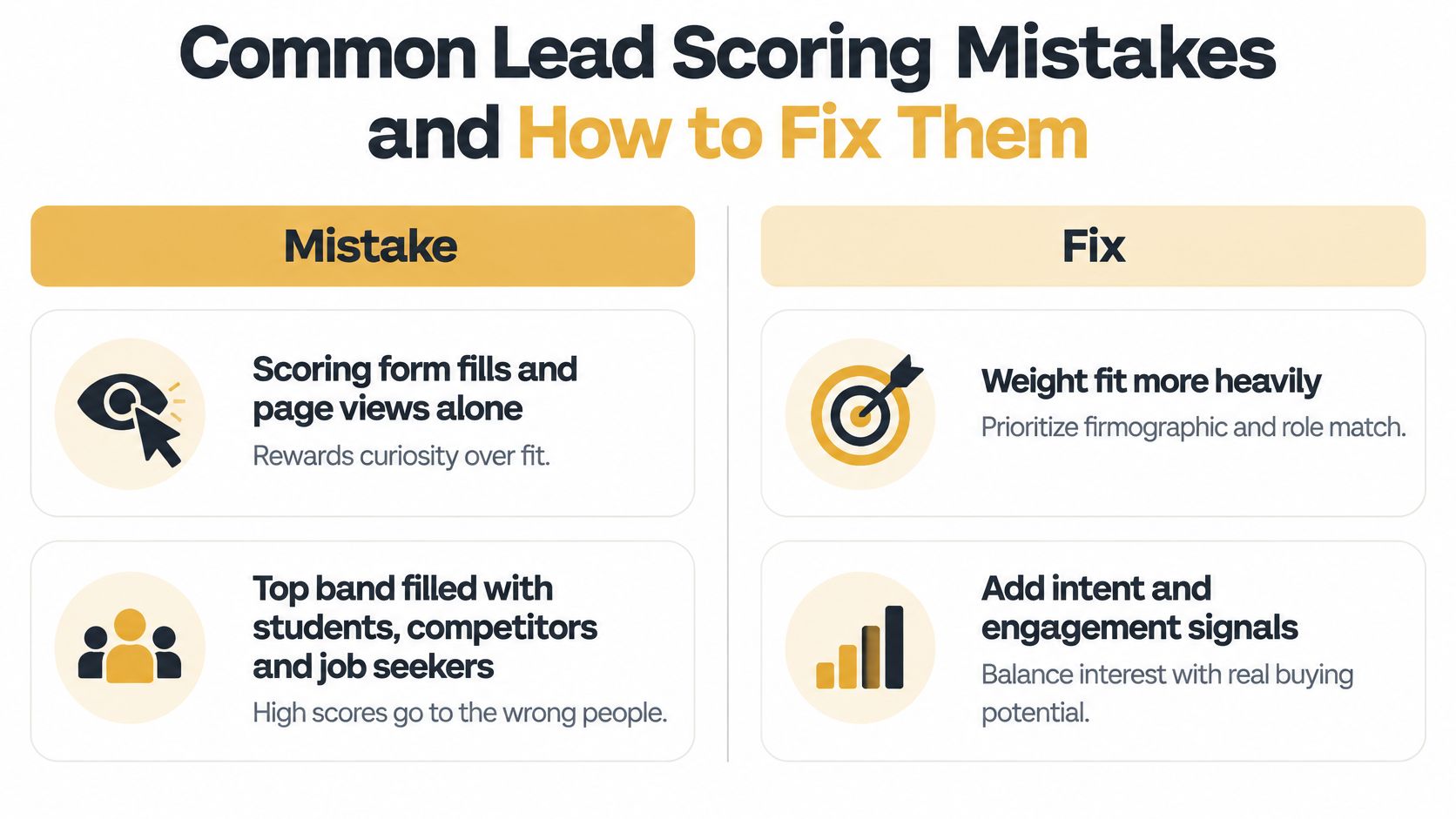
Scoring form fills and page views alone rewards curiosity rather than customer suitability. A warning sign is a top band filled with students, competitors, and job seekers instead of plausible buyers.
The fix is to weight firmographic fit and relevant dated signals before treating browsing activity as sales readiness. Engagement remains useful, but it shouldn't erase a fundamental mismatch.
Diagnose the operating problem
| Mistake | Sign | Fix |
|---|---|---|
| Too many attributes | Reps can't explain what raises or lowers the number | Keep the candidate list short and remove attributes that add no useful separation |
| The same event counts as fit and timing | A recently funded company ranks highly despite missing every target segment | Give each signal a defined role and prevent duplicate credit |
| High scores are treated as promised meetings | Reps abandon promising accounts after an unanswered attempt | Judge bands by observed meeting outcomes rather than individual replies |
| Sales and marketing use different definitions | Scores rise while accepted pipeline doesn't | Agree on a written qualification definition and required evidence |
| Old events retain full weight | Long-expired business changes still dominate the queue | Apply decay and preserve the original signal date |
| Precision goes unmonitored | Reps quietly reject growing portions of the top band | Review rejection reasons alongside qualification outcomes |
A hypothetical first model with more than about ten attributes should prompt a simplification review, not automatic rejection. An attribute earns its place by changing a useful decision, not by being available in the CRM.
The manager's diagnostic question is concrete: What would the rep do differently because this field exists? If the answer is unclear, the field probably belongs in the account record rather than the scoring formula.
Start a Simple Scoring Model This Week
A short pilot should produce a documented model and a testable queue, not a claim that qualification has been solved. The following is a hypothetical working schedule.
- Day one: Pull 20 to 50 closed deals with close dates, preserving won and lost outcomes for comparison.
- Day two: Write the fit rules and check whether they distinguish wins from unsuitable accounts.
- Day three: Add two or three dated timing signals, each with an explicit decay window.
- Day four: Set score bands, owners, approval requirements, and routing based on rep capacity.
- Day five: Backtest the last two quarters using an older-to-newer time split, then compare the top and bottom bands.
If historical wins rank near the top without outcome leakage, run a small pilot through sales campaigns and review each result. Sales Montana offers a 7-day free trial with 100 credits, no card needed; teams wanting outbound run for them can use trained SDRs, with every send approved by a human.
Sales Montana connects dated buying signals, lead prioritization, and human-approved outbound in the same workflow. Visit Sales Montana to start with an ideal customer description, inspect the reasons behind the selected leads, and build a campaign from the accounts worth pursuing.
Let Montana run your outbound
Leads, calls, email and LinkedIn in one place. 7 day free trial with 100 credits, no card needed.
Larger team? Book a demo